
Trump’s Secret Plane Swap Amid Iran Threat
A highly unusual security operation reportedly unfolded during U.S. President Donald Trump’s departure from Turkiye following the NATO summit in Ankara last month.
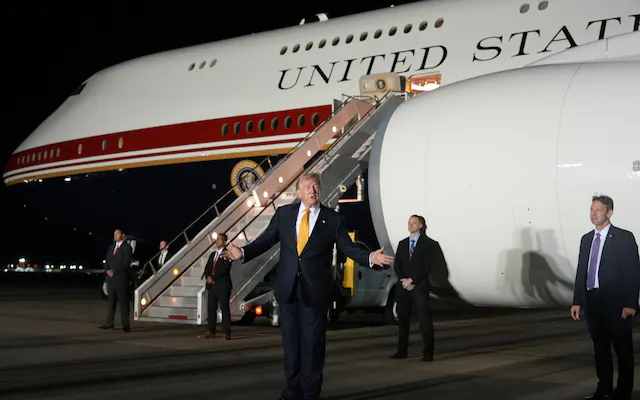
A highly unusual security operation reportedly unfolded during U.S. President Donald Trump’s departure from Turkiye following the NATO summit in Ankara last month. According to reporting by The Washington Post, Trump was secretly moved from the legacy Air Force One aircraft to a smaller U.S. military aircraft after intelligence officials identified a potential Iranian threat against him.
A Carefully Planned Deception
The reported operation involved a remarkable deception. Trump publicly boarded the older Air Force One, creating the impression that he would travel from Ankara to the United Kingdom aboard the presidential aircraft. However, shortly after boarding, he was reportedly transferred to a smaller Air Force C-32A military aircraft using an airport catering truck.
Journalists and some White House personnel apparently remained aboard the larger aircraft and were unaware that the president had already been moved. The legacy Air Force One subsequently continued toward Britain, effectively serving as a decoy.
The operation was reportedly designed to conceal Trump's actual location and reduce the possibility that an adversary could identify and target the aircraft carrying the president.
Why Iran Was Central to the Operation
The reported security measures came amid extremely heightened tensions between Washington and Tehran. According to the reporting, U.S. officials regarded the threat against Trump as serious enough to justify an unusually complex deception operation.
The incident demonstrates how geopolitical confrontation can directly affect presidential security and military planning. When tensions between states escalate, even routine diplomatic travel can become a potential security vulnerability.
For Washington, protecting the president is not simply a matter of physical security. Presidential movements can themselves become intelligence targets, particularly during periods of military confrontation.
The Role of Air Force One as a Decoy
One of the most significant aspects of the operation was the use of the presidential aircraft as a deception mechanism.
Trump had publicly indicated that he would use the older, familiar Air Force One aircraft for the journey to Britain, while the newer Boeing 747-8 reportedly gifted by Qatar would travel separately. The newer aircraft had raised security questions because of its recent modifications and its role in presidential transportation.
The deception continued after departure. Journalists aboard the legacy Air Force One were reportedly instructed to keep their window shades closed, limiting their ability to observe the aircraft's surroundings.
After arriving at RAF Mildenhall in Britain, Trump was later seen exiting the legacy Air Force One, helping preserve the appearance that he had traveled on that aircraft for the entire journey.
A Broader Geopolitical Message
Beyond the unusual circumstances, the incident highlights the broader consequences of the confrontation between the United States and Iran.
When relations between two countries reach a point where senior political leaders must alter international travel arrangements because of potential assassination threats, diplomatic tensions have moved beyond conventional political disagreements.
It also illustrates the growing importance of strategic deception, intelligence protection and operational security in modern international politics.
For Iran, any perceived threat against a U.S. president would carry enormous strategic consequences. For Washington, protecting the president while maintaining diplomatic and military operations requires balancing transparency with secrecy.
What This Means for U.S.-Iran Relations
The reported operation is another indication of the extremely fragile security environment surrounding U.S.-Iran relations.
Instead of merely affecting negotiations, sanctions or military deployments, the confrontation is now reportedly influencing presidential travel and security protocols.
The incident may therefore become significant in understanding the evolution of U.S.-Iran tensions. It shows that geopolitical rivalry can produce consequences far beyond the battlefield including intelligence operations, diplomatic travel, presidential protection and strategic communication.
Conclusion
The reported catering-truck transfer may sound extraordinary, but its underlying message is serious:
The security environment surrounding the United States and Iran has become exceptionally dangerous.
The operation also demonstrates the continuing importance of deception in protecting political leaders during periods of international crisis. By creating uncertainty over Trump's actual location, U.S. security officials reportedly sought to prevent a potential adversary from identifying the president's aircraft.
Ultimately, the episode reflects a broader reality of contemporary geopolitics: when strategic tensions escalate, even the movement of a head of state can become an element of national security strategy.